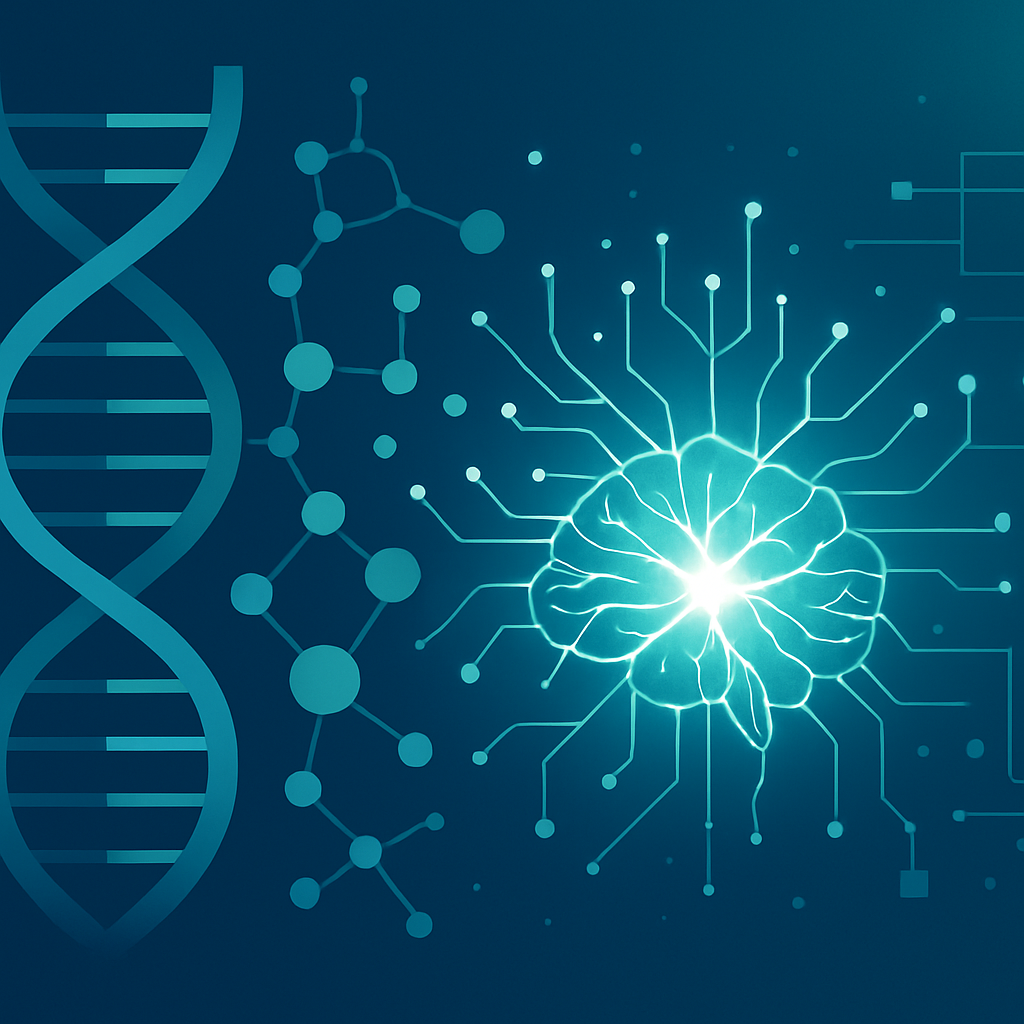
AI for Science: From Literature to Living Hypotheses
The fourth pillar of production-grade AI applies frontier models to discovery itself—reading the literature, generating hypotheses, simulating experiments, and acting as a research copilot for scientists.
The Fourth Pillar
Infrastructure, methodology, and domain applications move AI from prototype to production. But the highest-leverage use of AI may be on the process that creates new knowledge in the first place: science. AI for Science applies frontier models to the scientific method itself—accelerating the loop of read, hypothesize, simulate, experiment, and learn.
This isn't about replacing scientists. It's about giving them a tireless collaborator that reasons over the entirety of human research and proposes the next best experiment.
Literature Intelligence
No human can read the millions of papers, patents, and datasets relevant to a serious research question. We build systems that can—turning the literature into a structured, queryable knowledge graph.
- Evidence synthesis: Aggregate findings across thousands of studies and surface where they agree, conflict, or leave gaps.
- Whitespace detection: Identify under-explored connections between entities—genes, compounds, mechanisms—that warrant investigation.
- Provenance: Every claim links back to its source so scientists can verify, not just trust.
The Research Copilot
Grounded assistants help scientists design experiments, interpret results, and draft protocols and manuscripts. Unlike generic chatbots, a research copilot is anchored in your data and the verified literature, with citations attached to every assertion.
- Suggest experimental designs and controls based on prior art
- Interpret assay results in the context of known mechanisms
- Draft methods sections, with traceable references
Scientific Digital Twins
Wet-lab experiments are expensive and slow. Scientific digital twins—high-fidelity simulations of cells, molecules, and processes—let teams test interventions in silico before committing resources.
By simulating candidate interventions first, researchers triage thousands of ideas down to the few worth running physically, dramatically reducing dead-end experiments.
Hypothesis Generation
The hardest part of science is often asking the right question. We use causal and generative models to propose novel, testable hypotheses—then rank them by expected information gain and feasibility.
- Causal grounding: Prioritize hypotheses about mechanisms, not just correlations.
- Active learning: Choose the experiments that most reduce uncertainty.
- Feasibility scoring: Balance scientific value against cost and time.
Computational Biology
Protein structure and sequence models, omics analysis, and variant effect prediction underpin modern discovery. We build these on production-grade pipelines—versioned, monitored, and reproducible—so results are trustworthy at scale.
Closing the Loop
The real power emerges when these capabilities connect into a closed loop: literature intelligence informs hypothesis generation, digital twins simulate the most promising ideas, experiments validate them, and the results feed back to sharpen the next cycle. Discovery compounds.
Key Takeaway
AI for Science is the fourth pillar of our framework because it changes what's possible, not just what's efficient. Built on the same infrastructure, causal rigor, and governance as the other pillars, it turns the scientific method into a faster, smarter, and more systematic engine for discovery.
Sean Li
Founder & Principal Consultant at Duoduo Tech. Specializes in production-grade AI infrastructure, causal inference, and domain-specific ML applications across Life Sciences, Finance, and Media.