Building Production-Grade ML Systems: A Technical Deep Dive
From feature stores to model monitoring, here's the complete technical architecture for scaling ML from prototype to production.
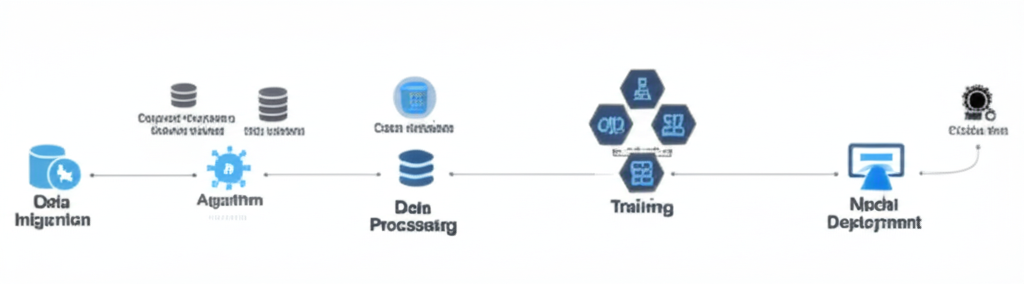
The Production ML Stack
Building a machine learning model is the easy part. The hard part is architecting the infrastructure to train, deploy, monitor, and iterate on that model at scale—reliably, securely, and cost-effectively.
Here's the complete technical architecture we implement for clients.
Layer 1: Data Infrastructure
Data Lake & Warehouse
- Storage: S3/GCS for raw data (parquet/delta format for efficient queries)
- Warehouse: Snowflake, BigQuery, or Redshift for structured analytics
- Streaming: Kafka/Kinesis for real-time data ingestion
Data Versioning
Models trained on different data versions must be reproducible. We use:
- DVC (Data Version Control) for dataset versioning
- Delta Lake/Iceberg for time-travel queries
- Metadata catalogs (DataHub, Amundsen) for lineage tracking
Layer 2: Feature Engineering
Feature Store
The most critical (and most overlooked) component. A feature store ensures:
- Training-serving consistency: Same feature computation in offline training and online inference
- Feature reuse: Multiple models share features
- Low latency: Pre-computed features served in <10ms
We typically implement:
- Feast (open-source): Good for startups/mid-size companies
- Tecton (managed): Enterprise-grade, worth the cost for large-scale deployments
- Custom: When you need domain-specific transformations
Layer 3: Model Training & Experimentation
Compute Infrastructure
- GPU clusters: Kubernetes with NVIDIA GPU operator for distributed training
- Spot instances: 70% cost savings for interruptible workloads
- Experiment tracking: MLflow or Weights & Biases
Hyperparameter Optimization
Automated search (Optuna, Ray Tune) integrated with distributed training. We typically see 10-20% accuracy improvements from proper hyperparameter tuning alone.
Layer 4: Model Deployment
Serving Architecture
Three common patterns:
1. REST API (Most Common)
Model Container (TensorFlow Serving / TorchServe)
↓
API Gateway (rate limiting, auth)
↓
Load Balancer (auto-scaling)
2. Batch Inference
For non-real-time predictions (e.g., daily churn scores). Spark/Airflow orchestrates batch jobs.
3. Edge Deployment
For latency-critical applications. We use ONNX Runtime or TensorFlow Lite for on-device inference.
CI/CD Pipeline
- Data scientist commits model to Git
- CI runs validation tests (data checks, model performance benchmarks)
- Model is containerized and pushed to registry
- CD deploys to staging → canary (5% traffic) → full production
- Automatic rollback if error rates spike
Layer 5: Monitoring & Observability
What We Monitor
- System metrics: Latency (p50, p99), throughput, error rates
- Data drift: Input distribution shifts (KL divergence, PSI)
- Prediction drift: Output distribution changes
- Model performance: Accuracy, precision, recall (requires ground truth labels)
- Business metrics: Revenue impact, user engagement
Alerting Rules
We set up alerts for:
- Latency spikes (p99 > 200ms)
- Error rate increase (>1% of requests)
- Data drift detected (PSI > 0.2)
- Model accuracy drop (>5% below baseline)
Layer 6: Governance & Security
Model Lineage
Track every model back to:
- Training dataset version
- Code commit (Git SHA)
- Hyperparameters
- Training metrics
Security Controls
- Data encryption (at rest and in transit)
- Access controls (RBAC for model deployment)
- Audit logs (who deployed what model when)
- Model explainability (SHAP, LIME) for regulatory compliance
Cost Optimization
ML infrastructure can get expensive fast. We optimize:
- Training: Spot instances, early stopping, gradient accumulation
- Inference: Model quantization (INT8), batching, caching
- Storage: Data lifecycle policies (archive old training data)
The Full System
When all layers work together:
- Data scientists iterate fast (experiment tracking, automated training)
- Models deploy reliably (CI/CD, containerization)
- Operations stay ahead of issues (monitoring, alerting)
- Business trusts the system (governance, explainability)
That's production-grade ML. It's not about one model—it's about building a platform that enables hundreds of models to succeed.
Sean Li
Founder & Principal Consultant at Duoduo Tech. Specializes in production-grade AI infrastructure, causal inference, and domain-specific ML applications across Life Sciences, Finance, and Media.