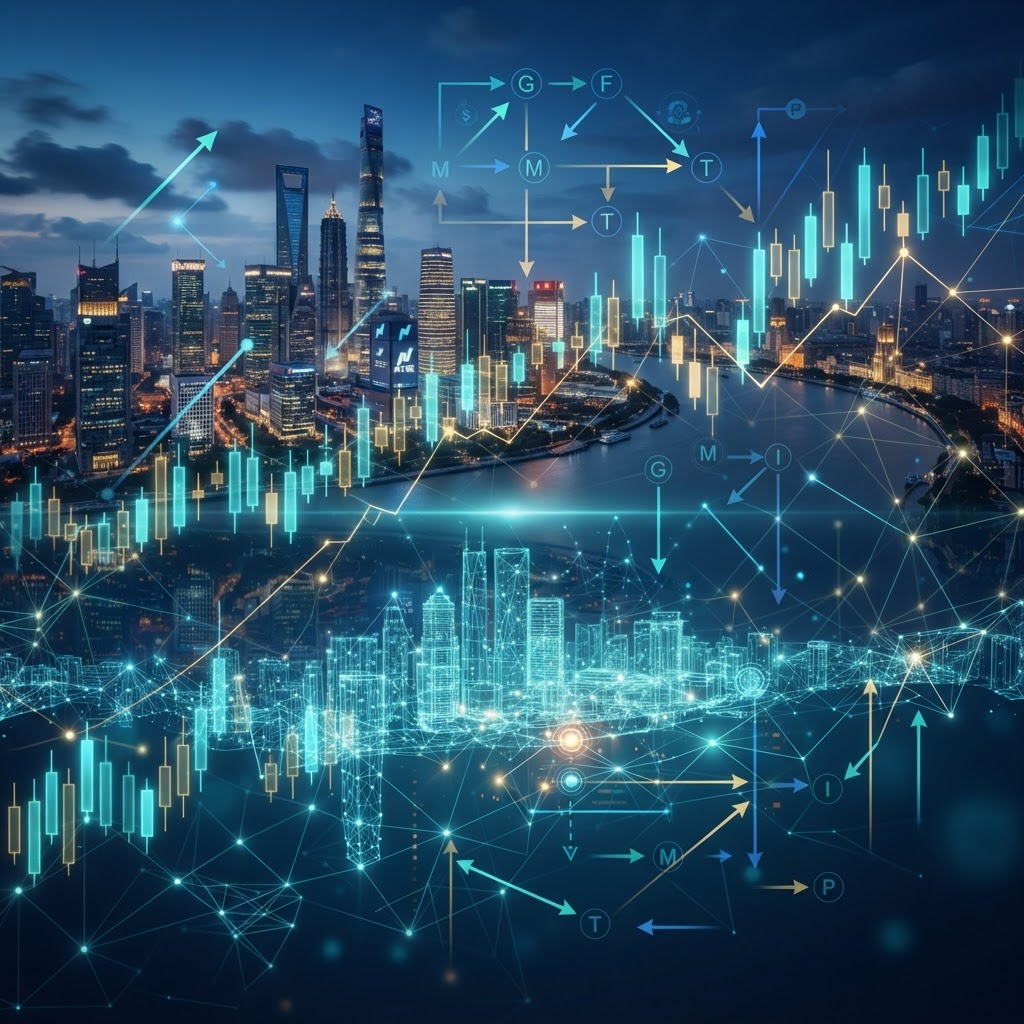
Digital Twins and Causal AI in Finance: Simulating Money Before You Move It
Digital twins reveal what is happening inside a financial system; causal AI explains why and what changes if you intervene. Together they let banks run virtual experiments before risking real capital.
Digital twins and causal AI are becoming increasingly important in finance, but they serve different roles. A digital twin answers "What is happening inside my financial system?" Causal AI answers "Why did it happen, and what will happen if I change something?" When combined, they let financial institutions run virtual experiments before making real-world decisions.
What Is a Digital Twin in Finance?
Unlike manufacturing, finance has no physical machine to replicate. Instead, a digital twin is a living computational model of a financial system—a bank, an investment portfolio, a stock market, an insurance company, an economy, a payment network, or even an individual customer. Think of it as a continuously updated simulator.
Real Bank
     │
Transactions · Customer Behavior · Interest Rates · Fraud · Market Prices
     │
     ▼
Digital Twin
     │
Simulate Future Policies & Risks
Digital Twin of a Bank
Imagine a bank wants to know: "What happens if the Fed increases interest rates another 1%?" Instead of waiting, it builds a twin containing deposits, loans, customer behavior, mortgages, liquidity, regulations, and default models—then simulates. No real money is lost.
Interest ↑
   →  Mortgage payment ↑
   →  Some customers default
   →  Loan losses ↑
   →  Bank capital ↓
   →  Need more reserves
Digital Twin of a Portfolio
Suppose a hedge fund holds Apple, Microsoft, gold, oil, Bitcoin, and Treasuries. The twin captures market prices, correlations, volatility, macro variables, and investor behavior. Thousands of scenarios can be explored before a single trade is placed.
Oil crisis
   →  Inflation
   →  Fed raises rates
   →  Technology stocks fall
   →  Treasuries recover later
   →  Portfolio value changes
Digital Twin of Customers
Banks increasingly build customer twins. Each customer has income, spending, salary, credit score, loan history, investment habits, family, and location. The twin predicts who is likely to refinance, default, buy insurance, leave the bank, or respond to a promotion.
Where Causal AI Enters
Traditional AI predicts—for example, "customer default probability = 8%." Useful, but management asks why? Prediction cannot answer that. Causal AI attempts to explain the likely pathway.
Income drop
   →  Higher credit utilization
   →  Missed payments
   →  Default
Counterfactual Reasoning
This is where causal AI becomes especially valuable. If a customer with $60k income defaulted, causal AI can ask: would default still occur if income were $75k? Or if we reduced the interest rate? This supports intervention planning rather than prediction alone.
Combining Digital Twin + Causal AI
Suppose a bank wants to lower defaults. Prediction alone says "default = 7%" and stops there. Causal AI identifies the pathway (higher interest → higher payment burden → default), and the twin then tests interventions and compares strategies before deploying them.
| Intervention | Simulated Default Rate |
|---|---|
| Reduce rate 0.5% | 5% |
| Extend loan maturity | 4% |
| Temporary payment holiday | 2% |
Fraud Detection
Prediction says "transaction: 98% fraud." Causal AI asks why, tracing a chain—new device → different country → impossible travel → unusual merchant → fraud. The twin then simulates trade-offs: confirming the device drops fraud probability, while requiring biometric authentication reduces fraud but increases customer inconvenience.
Algorithmic Trading
Here the twin is often a multi-agent simulation of market participants—institutional investors, retail investors, market makers, news, and liquidity. Each agent observes the market, reasons, trades, and moves price. Causal AI then estimates why price moved (news, the Fed, a large institution, momentum, retail panic), and the twin tests scenarios like "what if hedge funds sell 5%?" or "what if liquidity dries up?"
Credit Underwriting
Traditional ML answers "approve? yes." Causal AI exposes the risk pathway (low income → high debt ratio → high default risk), and twin simulation quantifies the effect of lending decisions: increasing a loan by $20k raises default 12%, while reducing the amount drops it 7%.
Stress Testing
Banks already run stress tests. Digital twins make them more realistic by capturing interactions over time rather than static equations.
Recession
   →  Unemployment ↑
   →  Consumer spending ↓
   →  Business failures ↑
   →  Loan defaults ↑
   →  Bank capital ↓
Insurance and Central Banks
In insurance, a twin links customers, driving, weather, health, and claims, while causal AI reveals how a premium increase can drive customers away and reduce revenue—letting simulations balance pricing, retention, and profitability. Central banks increasingly use macroeconomic models that resemble twins, including households, firms, banks, government, trade, inflation, and the labor market, with causal reasoning helping distinguish whether inflation changes stem from policy or other factors.
A Typical Modern Architecture
              Live Data
                  │
        Market Data · Customer Data
                  │
             Digital Twin
                  │
 Simulation · Optimization · Agent-Based Model
                  │
             Causal Model
          (SCM / DAG / DoWhy)
                  │
 Counterfactuals · Policy Tests · Root Cause
                  │
            Decision Engine
                  │
             Human Approval
                  │
            Real Deployment
Toward an Economic Digital Twin
The most promising frontier combines causal AI, agent-based modeling, and digital twins into an economic digital twin—simulating not a single bank but an entire financial ecosystem. Agents (households, businesses, banks, investors, regulators, and the central bank) spend, borrow, lend, invest, and save; a causal model captures how interest rates, unemployment, inflation, regulation, and sentiment shape those decisions; and the twin stays synchronized with real-world data.
Such a platform could answer questions like: What happens if mortgage rates rise 1%? How would a tax incentive affect small-business investment? Which customer segments benefit most from a refinancing program? How might a liquidity shock propagate through interconnected banks? What combination of policies minimizes defaults while preserving profitability?
Key Takeaway
Digital twins and causal AI answer complementary questions—what is happening versus why, and what if. Fused into one decision-support system with simulation, optimization, and real-time data, they let financial institutions rehearse the consequences of a decision before a single dollar moves. This is where digital twins, causal inference, agentic AI, and simulation naturally converge into financial decision intelligence.
Sean Li
Founder & Principal Consultant at Duoduo Tech. Specializes in production-grade AI infrastructure, causal inference, and domain-specific ML applications across Life Sciences, Finance, and Media.