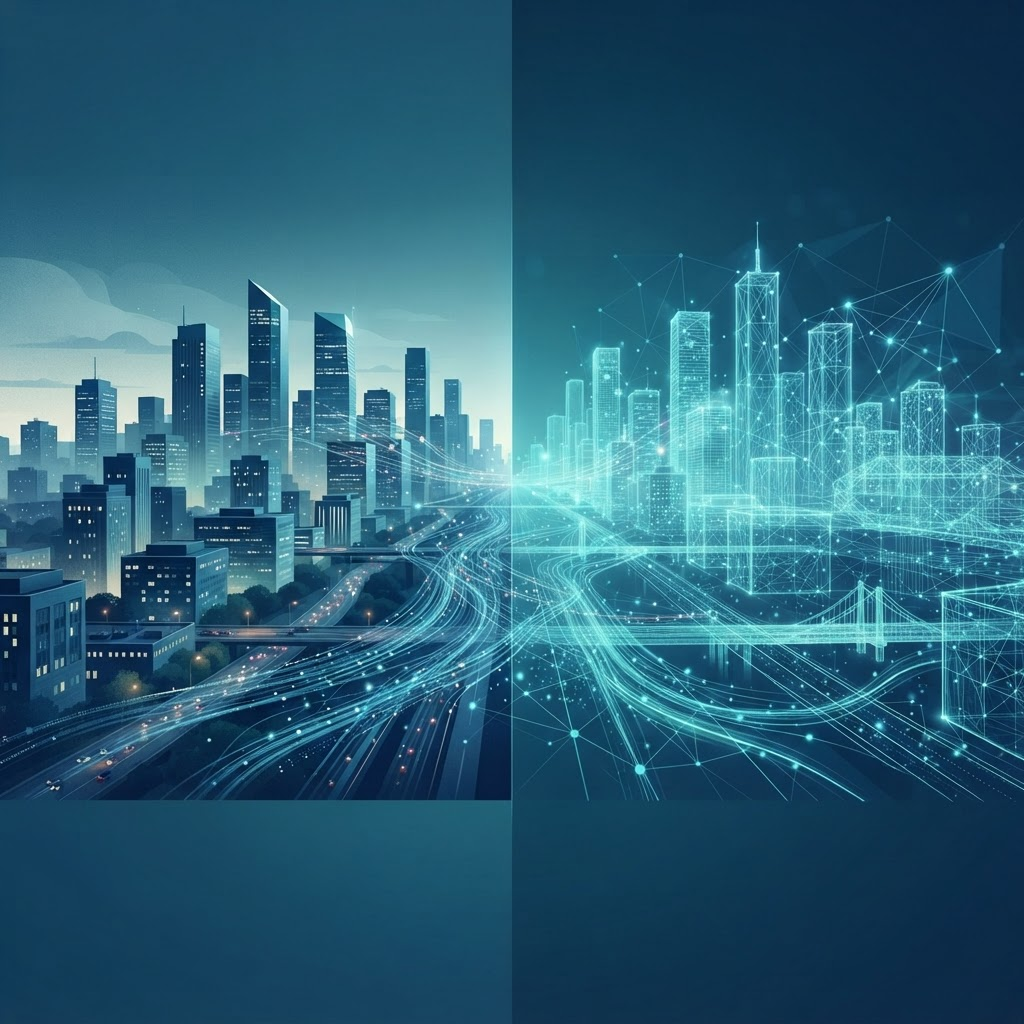
Digital Twins: Simulating Reality Before You Change It
A digital twin is not another algorithm—it's an integrated scientific platform that fuses machine learning, causal inference, and simulation so you can test 'what if' before intervening in the real world.
Prediction Is Not Enough
Machine learning has become extraordinarily good at answering one question: "What is likely to happen?" But the decisions that matter most in business and policy hinge on a different question entirely: "What will happen if we intervene?"
A digital twin bridges that gap. It is a continuously updated computational representation of a real system that lets you test "what if" scenarios before changing the real world. That makes it a natural meeting point for AI, causal reasoning, simulation, and decision intelligence.
A digital twin is a continuously updated computational representation of a real system that lets you test interventions before committing to them in reality.
A Living Scientific Laboratory
The progression from raw reality to actionable policy follows a clear arc. Instead of experimenting on society itself, we experiment on the twin:
Reality
   →  Data Collection
   →  Machine Learning
   →  Causal Model
   →  Simulation
   →  Digital Twin
   →  Policy Testing
1. AI & Society
Consider a policy question: Should governments regulate AI-generated content? Without a twin, you pass the regulation, wait two years, and observe the consequences—an expensive and irreversible experiment.
With a digital twin, you populate a virtual world of citizens, social platforms, AI companies, and regulators, then run the simulation to observe outcomes—misinformation spread, innovation, business costs, public trust, and political polarization—before the policy is ever enacted. The relevant mathematics spans causal inference, game theory, multi-agent systems, reinforcement learning, and Bayesian decision theory.
2. Computational Social Science
Given data from social platforms, census records, and mobile phones, machine learning discovers patterns. A digital twin goes a step further. Rather than merely reporting that "people moved," it asks what happens if subway fares increase by 20%—simulating millions of individuals, each deciding differently.
Increase subway fare
   →  People drive
   →  Road congestion
   →  Air pollution
   →  Hospital visits
   →  Economic productivity
A single policy now ripples through many systems simultaneously.
3. Complex Systems Analysis
Cities, electrical grids, ecosystems, economies, and supply chains all share one trait: dense feedback loops. Traditional machine learning struggles with long feedback chains, while digital twins represent them naturally.
Population → Traffic → Pollution → Health
   → Healthcare costs → Taxes → Infrastructure → Traffic
Typical tools here include differential equations, dynamical systems, agent-based simulation, system dynamics, and network science.
4. Social Network Analysis
When information flows through a network of connections, a twin lets researchers run virtual experiments: What if a node receives a fact-check? What if an account is suspended? What if influencers are promoted differently? Machine learning discovers the network structure; the digital twin explores how it evolves.
5. Agent-Based Modeling
Digital twins are frequently built on agent-based models, where each agent makes decisions and takes actions, and society emerges from their interactions. The key distinction: traditional agent-based modeling uses a synthetic population, while a digital twin binds a real system to real data with continuous updates—keeping the twin synchronized with reality.
Picture a digital customer twin, where each virtual customer carries income, preferences, purchase history, reviews, budget, patience, and brand loyalty. A marketing change is applied, virtual customers react, sales are predicted, and the change is deployed only if it proves beneficial.
6. Public Health
Perhaps the best-known application. Instead of testing lockdowns on real people, you simulate first. A twin containing hospitals, doctors, patients, households, workplaces, and transportation can estimate infections, ICU demand, deaths, costs, and economic impact under scenarios like school closures, 70% vaccination coverage, mask mandates, or a new variant.
Where Each Discipline Fits
Machine learning helps build the twin—hospital records train a readmission model that gets embedded and called repeatedly during simulation. ML predicts each individual's behavior; simulation predicts the behavior of society.
Causal inference supplies the intervention effects. ML might observe that older people are hospitalized more often; causal inference estimates how much hospitalization decreases if vaccination increases. Those causal effects become rules inside the twin.
Large language models make virtual humans more realistic. Instead of a rigid rule like "if price > $10, do not buy," an LLM-based agent can reason: "This is pricier than usual, but my friends left positive reviews and it's a trusted brand, so I'll buy it."
A Unified Architecture
A modern digital twin integrates several layers into a single decision-support system:
              Real World
                  ↓
        Sensors / Databases
                  ↓
       Data Engineering Layer
                  ↓
  ML   ·   Causal Inference   ·   Network Analysis
                  ↓
          Digital Twin State
                  ↓
 Agent-Based Sim · System Dynamics · Optimization
                  ↓
           Scenario Engine
                  ↓
   Policy Evaluation / Decision Support
Why Digital Twins Are Becoming Central
Many researchers view the digital twin as the convergence point of multiple disciplines:
| Component | Role |
|---|---|
| Machine Learning | Learn patterns from historical data (prediction). |
| Causal Inference | Estimate how interventions change outcomes (cause and effect). |
| Social Network Analysis | Represent relationships and diffusion pathways. |
| Complex Systems Science | Model feedback loops and emergent behavior. |
| Agent-Based Modeling | Capture heterogeneous individual decisions and interactions. |
| Optimization & Decision Science | Search for the best policy under competing objectives. |
| Digital Twin | Integrate all of the above into a continuously updated virtual environment for testing decisions before acting. |
Key Takeaway
A digital twin is not another algorithm—it is an integrated scientific platform that combines prediction, causal reasoning, simulation, optimization, and real-time data into one decision-support system. That is why twins are being adopted across smart cities, healthcare, manufacturing, energy, logistics, and increasingly AI governance and computational social science. The organizations that master them will stop guessing at the consequences of their decisions and start rehearsing them.
Sean Li
Founder & Principal Consultant at Duoduo Tech. Specializes in production-grade AI infrastructure, causal inference, and domain-specific ML applications across Life Sciences, Finance, and Media.